Your thermostat reads 72°F, but your home feels cool and clammy. Skin feels damp, clothes cling, and a musty smell lingers. You are not dealing with a broken AC, you are dealing with an oversized one. Hutchinson Heating and Air has seen this problem repeatedly across Temecula and Murrieta homes.
An air conditioner has two jobs: cool the air and remove humidity. In Southern California’s inland valley climate, both matter equally. When a unit is too large for your space, it fails at both. Understanding exactly how does an oversized AC unit fail to dehumidify is the first step toward lasting comfort.
How a Properly Sized AC Removes Humidity
Before breaking down what goes wrong with an oversized system, it helps to understand what the right-sized system does correctly.
When your air conditioner runs, it pulls warm, humid air from inside your home through the return ducts. That air travels across the evaporator coil on a cold, metal surface filled with refrigerant running at around 40 to 50 degrees Fahrenheit. When the warm, moisture-laden air makes contact with that cold coil, it hits its dew point. Moisture condenses out of the air and collects on the coil surface, much like water droplets forming on a cold glass of lemonade on a hot day. That water drips down into a drain pan and exits through the condensate line, flowing outside your home. What remains is cooler, drier air that gets pushed back into your living spaces.
The key to this process is run time. The evaporator coil needs sustained contact with incoming air typically 20 to 30 minutes per cycle to drop to the temperature required for heavy condensation. In the first few minutes of a cycle, the coil is still warming up from the off period. It takes time for it to get cold enough to pull serious moisture out of the air. This is something the technicians at Hutchinson Heating and Air explain to homeowners regularly: a properly sized system runs long, steady cycles that give the coil enough time to do both jobs, cool the air and drain the humidity out of it. That is exactly what an oversized system disrupts.
How Does an Oversized AC Unit Fail to Dehumidify?
The answer comes down to one mechanical failure that triggers a chain reaction throughout the entire system.
1. The Short-Cycling Trap
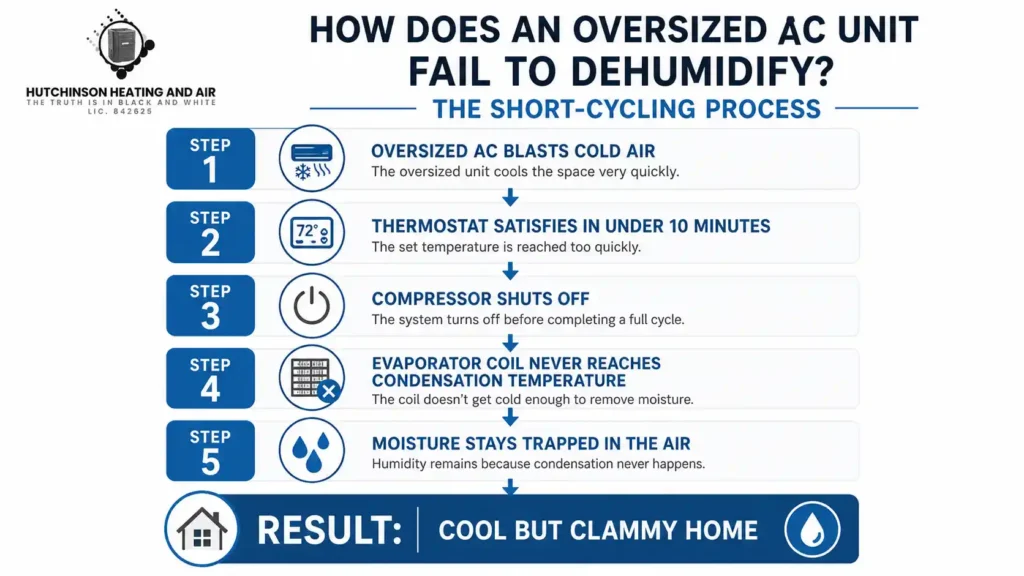
An oversized air conditioner has more cooling capacity than your home actually needs. The moment it kicks on, it blasts the space with a massive volume of cold air. Your home’s temperature drops rapidly in some cases, hitting the thermostat’s target in eight to ten minutes or less. The thermostat reads the target temperature, considers the job done, and shuts the compressor off.
This is called short-cycling, and it is the core reason an oversized AC unit fails to dehumidify.
A normal, properly sized system might complete that same cooling job in 20 to 30 minutes. An oversized unit does it in under 10. The temperature is satisfied, but the humidity is not touched. Because the cycle ended so quickly, the moisture that was pulled from the air barely had time to condense on the coil and drain away. The water vapor that entered your home stays in your home.
The system then sits idle. The indoor temperature slowly climbs again. The thermostat triggers another cycle. The same rushed process repeats over and over, sometimes four to six times an hour and your air conditioner high humidity problem compounds with every incomplete cycle.
2. The Evaporator Coil Never Reaches Peak Efficiency
There is a thermal reality that most people never consider. When the AC system starts a cycle after sitting idle, the evaporator coil is not immediately at condensation temperature. It has to cool down from ambient conditions first. In a properly sized system, this warm-up period is a small fraction of the full run time. The coil spends most of the cycle at peak condensation efficiency.
In an oversized system, the compressor shuts off right around the time the coil is hitting its stride. By the time the metal surface has cooled enough to start sweating moisture heavily, the thermostat has already satisfied and killed the cycle. The coil never operates at peak dehumidification efficiency. The result is that the AC unit not removing humidity, feeling your house is cool to the thermometer but clammy to the skin.
3. Fan ON Mode Makes Everything Worse
Many homeowners, noticing that their home feels damp, switch the thermostat fan setting from AUTO to ON, thinking that more airflow will help dry things out. It does exactly the opposite.
When the fan runs continuously in ON mode, it keeps blowing air across the evaporator coil even during the compressor’s off period. The coil is covered in condensed moisture from the previous cycle moisture that had just been successfully pulled from your air. The constantly running fan picks that moisture right back up and blows it into your living spaces. Every bit of dehumidification work the system just completed gets undone. Always set your thermostat fan to AUTO, never ON.
Warning Signs Your AC Unit Is Oversized
Not every homeowner knows their system is oversized. Here are the signs that point directly to an AC unit not removing humidity due to improper sizing:
- Cooling cycles last under 10 minutes before the system shuts off
- Home feels cool but sticky the thermometer is satisfied but your body is not
- Indoor humidity consistently above 55% even with the AC running
- Rooms are uneven some spaces are cold while others stay warm
- AC turns on and off more than 3 to 4 times per hour
- Musty smells or visible mold forming in corners, bathrooms, or near vents
If two or more of these match your home, the sizing of your system deserves a serious second look.
The Hidden Dangers of Ignoring an Oversized AC
A little clamminess sounds like a minor inconvenience. Over time, however, the consequences of a short-cycling, under-dehumidifying system reach far beyond discomfort.
Mold and mildew growth. Indoor humidity above 55 percent creates a textbook environment for mold colonies to develop inside walls, beneath flooring, behind drywall, and in ductwork. Mold is not just a structural problem. It is a health hazard, triggering respiratory issues, allergies, and chronic sinus problems for anyone in the home.
Accelerated equipment failure. Every time a compressor starts up, it draws a surge of electrical current and places mechanical stress on the motor, capacitors, and contactors. A properly sized system starts six to eight times daily. An oversized short-cycling system can start 30 to 50 times daily creating 400 to 600 percent more wear events per day. Systems designed to last 15 to 20 years routinely fail at 8 to 10 years when they short-cycle consistently.
Higher energy bills. Each compressor starts to draw a significant spike of electricity. More starts per hour means more energy consumed, even though the system runs for shorter durations. Homeowners with oversized units often see higher monthly utility bills than neighbors with properly sized systems that run longer, more efficient cycles.
Declining air quality. Short cycles mean less air passes through the system’s filtration. Dust, pollen, pet dander, and other airborne particles are not properly captured. Residents may notice increased allergy symptoms or see dust accumulating faster than expected.
Why Temecula and Murrieta Homes Are Especially at Risk
The inland valley climate around Temecula and Murrieta creates a specific set of conditions that make proper AC sizing more important and more complicated than in coastal California communities.
Summers here bring intense dry heat that can exceed 100°F for weeks at a time. But the same region also experiences late-summer humidity swings tied to the North American monsoon pattern, where overnight humidity can spike significantly. This means a home’s cooling load varies dramatically across the season, and an oversized system that blasts through every cycle without dehumidifying properly leaves homes vulnerable precisely during the periods when humidity is highest.
Many homes in the area were seized by contractors who used square footage alone as their guide, a shortcut that ignores insulation quality, window types, ceiling heights, sun exposure, and actual BTU load requirements. The result is a region where oversized systems are more common than they should be, and where air conditioner high humidity complaints are a regular feature of summer service calls. The fix is not always a new unit. But it always starts with an honest assessment.
Scheduling regular AC Maintenance in Temecula & Murrieta ensures your system is evaluated for both performance and proper sizing catching short-cycling problems before they turn into compressor failures or mold remediation jobs.
How to Fix an Oversized AC That Won’t Dehumidify
There are a range of solutions depending on the age of your system, your budget, and how severely the oversizing is affecting performance.
1. Switch Thermostat Fan to AUTO Immediately
This costs nothing and takes 30 seconds. Set the fan to AUTO so it only runs during active cooling cycles. This alone stops the reintroduction of coil moisture into your air supply.
2. Lower the Blower Fan Speed
Reducing the fan speed slows the volume of air moving across the evaporator coil. Less airflow means each cubic foot of air spends more time in contact with the cold coil improving moisture condensation without changing the unit itself. An HVAC technician can adjust this setting on most systems.
3. Upgrade to a Variable-Speed Blower Motor
A variable-speed motor can run continuously at a low, quiet, energy-efficient speed rather than cycling between full blast and complete off. This dramatically improves dehumidification by giving the coil sustained airflow even when the compressor is not running at full capacity.
4. Install a Whole-House Dehumidifier
A dedicated whole-house dehumidifier integrates directly into your existing ductwork and operates on its own humidity sensor independent of the thermostat. It removes moisture even when the compressor is resting, filling the dehumidification gap that an oversized AC creates. This is the most effective interim solution when replacement is not yet practical.
5. Do NOT Close Vents Here’s Why
Closing supply registers to “slow down” the system seems logical but causes serious harm. Closed vents increase static pressure inside the ductwork. This forces the evaporator coil to work against restricted airflow, dropping its surface temperature below freezing. The coil ices over entirely, blocking all airflow and eliminating any dehumidification. Compressor damage often follows.
6. Right-Size Your System With a Manual J Load Calculation
The only permanent solution to an oversized AC problem is replacing the unit with one that is correctly sized through a proper Manual J Load Calculation. This engineering calculation accounts for square footage, insulation R-values, window type and orientation, ceiling height, local climate data, and actual BTU requirements. It is the difference between a system that guesses and one that performs.

Final Thought
A bigger air conditioner is not a better air conditioner. When a system is oversized for your home, it creates a cycle of problems that compound over time persistent humidity, deteriorating air quality, accelerating equipment wear, and energy bills that keep climbing. The cool-but-clammy feeling is not a quirk of your home. It is a signal that your system is failing at half its job.
Temecula and Murrieta homeowners deserve a system that was sized for their actual home, not a neighboring house, not last decade’s square-footage estimate, and not a contractor’s fastest shortcut. Hutchinson Heating and Air brings over 21 years of local experience, NATE-certified technicians, and honest load calculations to every assessment. Whether you need a whole-house dehumidifier, a blower motor upgrade, or a properly right-sized replacement system, the solution starts with a real inspection from someone who knows this climate.
Contact us today to schedule your AC assessment and find out whether your system is truly working for your home or working against it.
Frequently Asked Questions
How does an oversized AC unit fail to dehumidify?
An oversized AC cools the home too quickly, completing its cycle in under 10 minutes before the evaporator coil reaches the temperature needed to condense and drain moisture. The humidity remains trapped in the air, leaving the home feeling cool but clammy, a condition known as short-cycling. This directly answers how an oversized AC unit fails to dehumidify: speed without duration means cooling without drying.
What should the ideal indoor humidity level be?
For health and comfort, indoor relative humidity should stay between 30 and 50 percent. Levels above 55 percent create conditions where mold, mildew, and dust mites thrive. If your home consistently reads above this range despite the AC running, your system may be oversized or short-cycling.
Can I fix an oversized AC without replacing it?
Yes, in many cases. Switching the thermostat fan to AUTO, lowering the blower speed, installing a whole-house dehumidifier, or upgrading to a variable-speed motor can all reduce the air conditioner high humidity problem without requiring full system replacement. A professional assessment will identify which option suits your home best.
How do I know if my AC is short-cycling?
Track how long your system runs before shutting off. If cooling cycles consistently end in less than 10 minutes, or if the unit starts and stops more than three to four times per hour, short-cycling is likely occurring. This is the primary mechanical reason for an AC unit not removing humidity effectively.
Can an oversized AC cause mold problems?
Yes. Persistent indoor humidity above 55 percent the direct result of short-cycling dehumidification failure creates the moisture conditions that mold requires to grow. It often develops in areas with limited airflow: inside walls, under flooring, and within ductwork, making it difficult to detect until the problem is already significant.