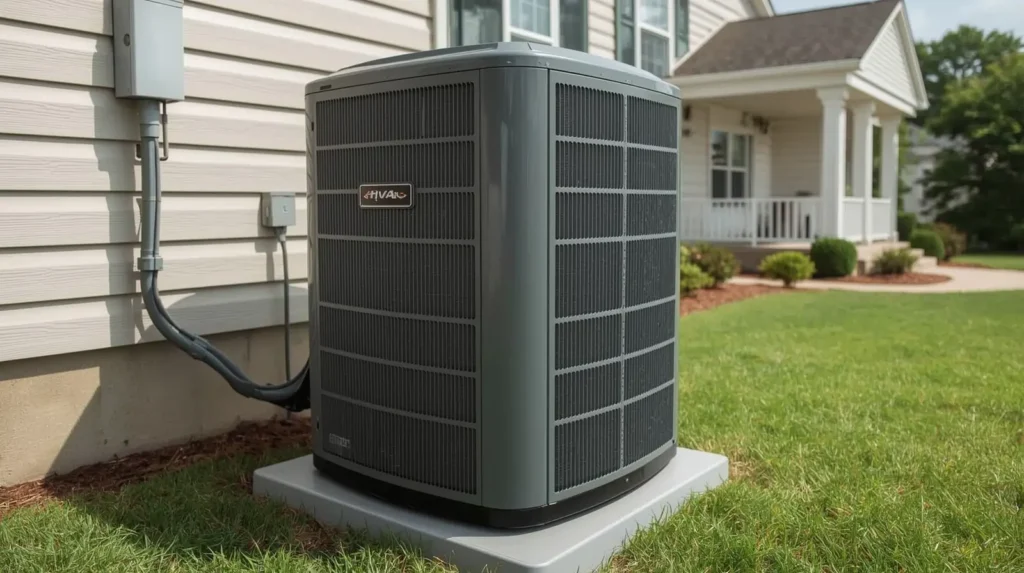
You have seen that metal box that is sitting outside your house it is humming away in the heat. A lot of people do not even notice the air conditioner condenser until it stops working on a hot Sunday when the temperature is 100 degrees. The air conditioner condenser is the reason why your bedroom’s not extremely hot, like a sauna right now. The air conditioner condenser is very important because it helps to keep your house cool.
Quick Answer: An air conditioner condenser is the outdoor component of your HVAC system that acts as a heat exchanger. Its job is to take the hot refrigerant gas coming from inside your home and turn it back into a liquid by “dumping” the heat into the outside air. Without this unit, your AC would just move warm air around without ever actually cooling it.
The Critical Function of an AC Condenser Unit
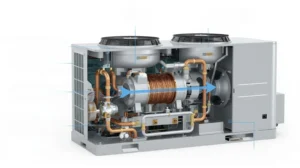
The air conditioner condenser unit is really important for making the air conditioning work. It is like the air conditioner unit that is inside your house is soaking up all the heat from your house. The air conditioner condenser unit outside is what gets rid of that heat.
When the hot air from the air conditioner unit inside your house gets to the air conditioner condenser unit outside it is really hot and under a lot of pressure. The fan that is outside pulls air, over the metal coils of the air conditioner condenser unit. That is how the heat gets out into the air. The air conditioner condenser unit is what makes the hot air cool down.
In my years of troubleshooting central air condenser systems, I’ve seen how this interaction is the “make or break” for efficiency. The process of condensation—turning gas back to liquid—requires a massive amount of airflow. If that airflow is blocked, the heat stays in the refrigerant, your compressor works double-time, and eventually, the whole system just gives up. It’s a crucial cycle that keeps your home habitable during the brutal summer months.
Read More: Condenser vs Compressor.
4 Key Components of an AC Condenser
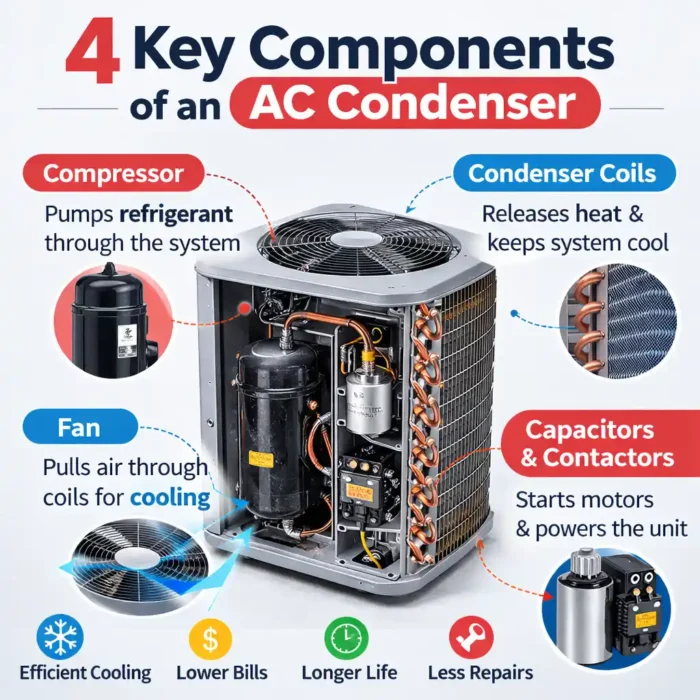
Inside that outdoor cabinet, there are four main parts that actually do the work. If even one of these fails, your cooling stops.
The Compressor: This is the heart of the system. It’s the loudest part you hear. It pumps the refrigerant through the lines.
Technician’s Note: If you hear a “hard start” (a loud thud when it turns on), your compressor is struggling. Replacing this can cost $1,500 to $2,500, so you want to keep it happy.
Condenser Coils: These are the thin metal fins wrapped around the unit. Their job is to maximize surface area so heat can escape. I’ve seen these get so dirty from lawn clippings and “cottonwood” fluff that they look like they’re wearing a sweater. A dirty coil can literally “cook” your compressor from the inside out.
The Fan: This sits on top and sucks air through the coils. I had a buddy whose fan motor died, and within an hour, his unit was so hot you couldn’t touch the side panel. No fan means no heat exchange.
Capacitors & Contactors: These are the small electrical “brains.” Capacitors are like batteries that give the motors a kickstart. They often bulge or “pop” during heatwaves. They are cheap to fix, but when they go, the whole unit stays dead silent.
Some Main Functions of Aircon Condenser
The aircon condenser is like a way for your aircon to get rid of heat. Here is what the aircon condenser actually does:
1. It gets rid of heat outside your home
The refrigerant gas from inside your home goes to the aircon condenser, which gets rid of the heat outside. That is why you feel hot air coming from the outdoor unit.
2. It changes the refrigerant from gas to liquid
After the aircon condenser gets rid of the heat the refrigerant cools down. Becomes liquid again so it can absorb more heat from inside your home.
3. It has the compressor and fan inside
The aircon condenser has the compressor, which makes the refrigerant have pressure and a fan that blows air through the coils to help get rid of heat faster.
4. It helps the aircon cool your home efficiently
If the aircon condenser is clean and working well it helps your whole aircon system work, at its best. If the coils are dirty it can make the work less well up to 30% less.

How Do HVAC Compressors and Condensers Differ From One Another?
The HVAC compressor vs. condenser controversy is a frequent query I receive. Despite their frequent interchangeability, the terms are not synonymous. The compressor is a particular pump that is concealed inside the condenser, which is the full outdoor unit (box, fan, coils).
Condenser is the engine bay, and compressor is the actual engine in an automobile. The compressor generates the pressure, while the condenser offers the cooling conditions for the refrigerant. Although it is impossible to have one without the other, being aware of the distinctions aids a technician in describing a repair charge to you.
Types of Heat Pump and HVAC Condensers
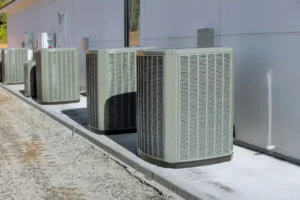
Not every outdoor unit is the same. Depending on your home, you likely have one of these:
- Split System Condensers: This is the “standard” box sitting on a pad outside. It’s “split” because half the system is inside (the evaporator) and half is outside (the condenser).
- Packaged Unit Condensers: Common in mobile homes or small commercial buildings. Everything—the heater, the blower, and the condenser—is shoved into one giant box, usually on the roof or a side slab.
- Heat Pump Condensers: These are the smartest of the bunch. In the summer, they work like a normal AC. In the winter, a “reversing valve” flips the flow, and they actually pull heat from the cold outside air to warm your house. It’s incredibly efficient compared to old-school electric furnaces.
The Importance of Air Conditioning Condensing Units
The air conditioning condensing unit houses all the necessary elements to expel the heat and make the air conditioning system work. The air condenser unit outside your home is crucial in maintaining energy efficiency. When the ac condenser releases heat to the environment, the air inside the home remains cool and comfortable, despite the outdoor temperature. Similarly, the house air conditioner condenser can be thought of as a kind of “heat dump,” where all the heat that the system extracts from inside your home is pushed out.
It’s important to understand that the air conditioning condenser unit does more than just release heat. It helps control the overall air conditioning system efficiency. A dirty or clogged central air condenser or house ac condenser may cause the system to overheat or perform inefficiently, which can lead to higher energy costs and a less comfortable living environment. Keeping the air conditioning condenser clean and well-maintained will ensure the longevity and efficiency of your entire HVAC system.
Why Aircon Condensers are the “Make or Break” of HVAC
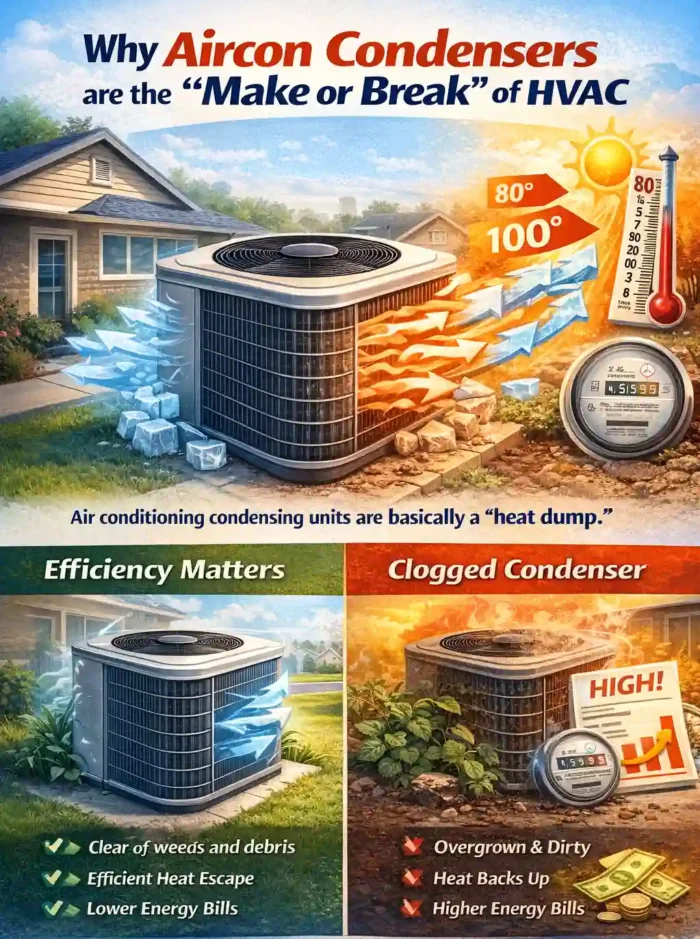
The air conditioning condensing unit is basically a “heat dump.” In a typical house AC condenser setup, the unit is fighting against the outdoor temperature. If it’s 100 degrees outside, your condenser has to work much harder to push heat out than if it were 80 degrees.
This is why efficiency matters. A clean air conditioner condenser allows heat to escape effortlessly. A neglected one acts like a clogged drain; the heat backs up, the pressure rises, and your electricity meter starts spinning like a top. Keeping the area around your unit clear of weeds and debris isn’t just about “curb appeal”—it’s about saving hundreds of dollars on your power bill.
Maintenance and Efficiency of AC Condensing Units
After inspecting hundreds of units, the #1 killer I see is lack of airflow. Homeowners often plant beautiful bushes around the unit to hide it, or they build a wooden fence right against it. This is a death sentence for the AC unit condenser.
The system needs at least 12–24 inches of “breathing room” on all sides. I once saw a unit that was “suffocating” because it was tucked under a low deck; it was recycling its own hot air, causing the compressor to burn out in just 4 years.
My Advice: Once a month, take a garden hose (never a pressure washer!) and gently rinse the dust and grass off the coils. It’s the easiest way to prevent a mid-summer meltdown.
Signs of a Failing Aircon Condenser
Your aircon is working hard but it is not cooling like it should? The aircon condenser might be failing. The aircon condenser is the unit that gets rid of heat from your home. When it has problems everything else has problems too.
Watch out for these warning signs:
- Air blowing inside your home. This is the biggest sign that something is wrong. If your aircon is running but it feels like it is just blowing air like a fan the aircon condenser is not getting rid of heat like it should.
- Your electricity bills are higher. When the aircon condenser is struggling it uses power but it does not cool your home any better.
- You hear noises like rattling or buzzing or clanking. These noises usually mean that something is loose or broken inside the aircon condenser.
- You see signs of leaking. If you see oil stains or ice around the aircon condenser you have a big problem that needs to be fixed right away.
- The aircon turns on and off many times. If this happens the aircon condenser might be getting too hot and turning itself off to protect itself.
If you do not pay attention to these signs your whole aircon system can stop working. If you catch these signs early you can save a lot of money on repairs.
How Do I Know if My AC Condenser is Bad?
Your AC usually gives you a few “warnings” before it dies completely:
- The “Lukewarm” Breeze: If the air coming from your vents isn’t ice-cold, the condenser likely isn’t dumping heat properly.
- Strange Noises: Squealing (fan motor), grinding (compressor), or buzzing (electrical) are all bad signs.
- Short Cycling: If the unit turns on and off every 2 minutes, it’s likely overheating or has a pressure issue.
- Leaking Fluid: If you see oily puddles around the outdoor unit, you likely have a refrigerant leak.
- The Ice Block: If you see ice on the copper pipes outside, stop! Your system is struggling and needs professional help immediately.
How Air Conditioner Condensers Fit into the Bigger Picture
The air conditioning condenser unit is part of a continuous loop. It receives high-pressure gas, cools it into a liquid, and sends it back to the “evaporator coil” inside your furnace or air handler. This cycle repeats thousands of times a day.
If the air conditioner condenser evaporator (the inside part) is dirty, the outside part suffers. If the outside part is dirty, the inside part freezes. It is a perfectly balanced system of pressures and temperatures. Understanding this “bigger picture” helps you realize that your AC isn’t just “blowing cold air”—it’s actually a sophisticated heat-moving machine.
Common AC Condenser Issues That Can Cause it to Go Bad
Clogged Fins: Dirt, dog hair, and dust act as insulation, keeping the heat inside the unit.
Bad Capacitors: These are the “AA batteries” of your AC. They fail more than any other part due to heat exhaustion.
Bent Fins: If someone hits the unit with a weed whacker, the metal fins bend and block air. You can actually “comb” these back out with a special tool.
Refrigerant Issues: Too much or too little “freon” will cause the condenser to fail its heat-exchange mission.
Age: Most units are built to last 10–15 years. If yours is older, the metal starts to corrode, and the compressor loses its “oomph.”
Conclusion
Alright, so now you know what that noisy box outside actually does. It’s not rocket science—just a few parts working together to move heat out of your house. Keep the thing clean, have someone look at it once a year, and you’ll probably be fine. But seriously, don’t ignore it when something seems off. The worst time to deal with a broken condenser is when it’s 95 degrees and you’re already sweating. If yours is acting up or making sounds it shouldn’t, just get it checked out. Our Temecula HVAC services team can come take a look and let you know what’s actually going on—Contact us before the heat hits.
Need Help with Your AC Condenser or HVAC System?
Whether it’s a failing aircon condenser or a complete system check, our expert HVAC team in Murrieta & Temecula is ready to assist you.
FAQs related to Aircon Condenser
What’s the difference between an HVAC condenser and an HVAC compressor?
The condenser is the entire outdoor cabinet and coil system; the compressor is the motorized pump inside that cabinet that moves the refrigerant.
Can a split system condenser save me money?
Absolutely. Modern split systems have much higher SEER2 ratings than older units, meaning they can provide the same cooling while using significantly less electricity.
How does a central air condenser compare to other types?
Central units are designed for high-volume cooling through ducts. They are much more powerful and durable than window units or portable ACs, but they require more maintenance.
What does the AC condenser use to work?
It uses high-voltage electricity and a chemical refrigerant. The electricity powers the motors, and the refrigerant acts as the vehicle that carries heat away from your home.