
Winter mornings in Temecula and Murrieta rarely feel brutal, but they still bite enough to make you reach for the thermostat before your coffee finishes brewing. What actually happens between that click and the warm air hitting your face? That is the question behind forced air heating, the system nearly every home in this region relies on.
At Hutchinson Heating and Air, we walk homeowners through this exact question every week, usually when a system starts acting up. This guide breaks down forced air heating in plain language, covering how it works, what local climate and 2026 efficiency changes mean for your home, and the safety details often overlooked.
Key Takeaways
- Forced air heating uses a furnace or heat pump to warm air, then pushes it through ductwork into every room using a blower fan.
- It is the most common heating method in Temecula and Murrieta homes because it doubles as the delivery system for air conditioning.
- Regular filter changes and annual inspections prevent most of the airflow and safety issues homeowners run into.
- Newer efficiency standards taking effect in 2026 are changing what “normal” heating costs look like for local households.
- Weak airflow, rising bills, or strange noises are early warning signs that a system needs professional attention before a small issue becomes a costly one.
What Is Forced Air Heating? (Quick Definition)
Forced air heating is a central heating method that warms air at a single source, typically a furnace or heat pump, and then pushes that heated air through a network of ducts to vents throughout the home. A blower fan does the actual “forcing,” moving air continuously until the thermostat senses the room has reached the target temperature.
The term covers more than just furnaces. Any system that heats air centrally and distributes it through ductwork qualifies, including heat pumps and certain electric air handlers. This is different from radiant heating, which warms objects and surfaces directly rather than circulating air.
How Forced Air Heating Works
The process is a loop, not a one-time event. Here is the sequence:
- The thermostat detects that indoor temperature has dropped below the set point and signals the system to start.
- The heat source activates. This might mean a gas burner ignites, an electric element heats up, or a heat pump begins pulling warmth from outside air.
- The blower motor turns on and pushes the newly heated air through the supply ducts.
- Warm air exits through vents in each room while the blower simultaneously pulls cooler air back through return ducts.
- That returning air passes over the heat exchanger again, gets reheated, and the cycle repeats until the thermostat is satisfied.
This constant cycling is what makes forced air heating feel fast compared to radiant systems, which can take much longer to bring a cold room up to temperature. It is also why duct condition matters so much. A leaky duct run loses conditioned air before it ever reaches the room, forcing the system to work harder and run longer than it should.
Key Components of a Forced Air System
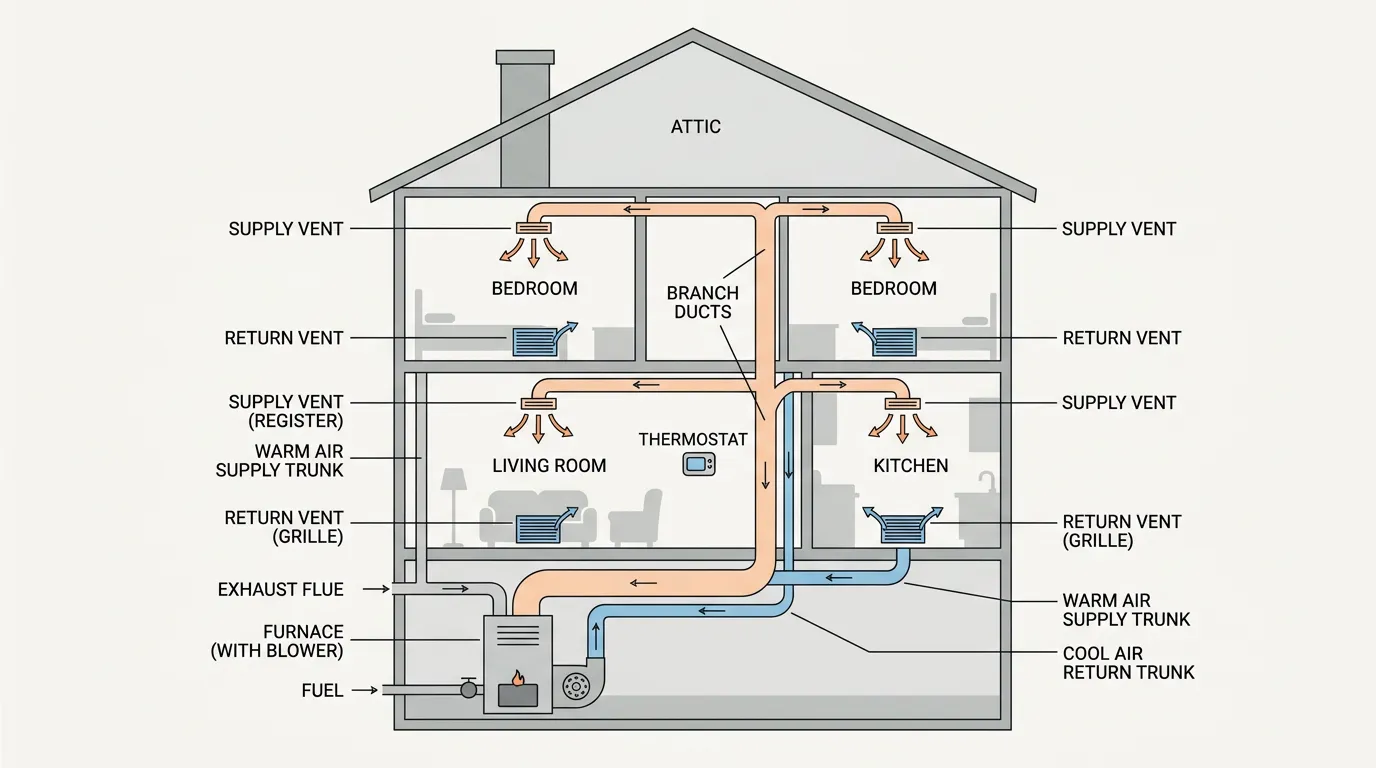 Every forced air heating system relies on a handful of core parts working together:
Furnace or heat pump. This is the heat source. Gas furnaces burn natural gas or propane in a sealed combustion chamber, while heat pumps move heat from outside air using a refrigeration cycle rather than generating it directly.
Blower motor. The fan responsible for moving air through the ductwork. Variable speed blowers, increasingly common in newer installs, adjust their output based on actual heating demand instead of running at one fixed speed.
Heat exchanger. The component where heat transfers into the air stream. In gas furnaces, this part separates combustion byproducts from the air you breathe, which makes its condition a genuine safety issue rather than just a performance one.
Ductwork. The network of supply and return ducts that carries air to and from every room. Poorly sealed or undersized ductwork is one of the most common reasons a forced air heating system underperforms even when the furnace itself is healthy.
Air filter. Traps dust, pet dander, and other particles before air recirculates. A clogged filter restricts airflow and forces the blower motor to strain, which shortens its lifespan.
Thermostat. The control point that reads room temperature and tells the system when to start and stop.
How It Differs from Other Heating Systems
Homeowners often use “forced air,” “central air,” and “central heating” interchangeably, but they are not identical concepts.
Forced air heating refers specifically to the method, using a blower to move heated or cooled air through ducts. Central air, by contrast, typically refers to the cooling half of that same setup, meaning the air conditioner or heat pump that chills the air. If your home has ductwork and vents in every room, you already have a forced air system, and adding central air conditioning to it is usually straightforward because the distribution infrastructure already exists.
Radiant heating is a completely different category. Instead of moving heated air, radiant systems warm objects and surfaces directly, often through hot water pipes in the floor or wall-mounted radiators. Radiant heat feels different, tends to be quieter, and does not circulate dust the way a forced air heating system does. However, it cannot double as an air conditioning delivery method, which is a major reason forced air remains dominant in Southern California homes built for both heating and cooling seasons.
The Pros and Cons of Forced Air Heating
The Pros
Forced air heating warms a home noticeably faster than radiant alternatives because air has a lower thermal mass and responds quickly to temperature changes. It also integrates naturally with air conditioning, air filtration, and humidification, since all three can share the same ductwork. Installation costs tend to be lower than hydronic or radiant systems because there is no boiler or hot water piping involved, and repairs are generally more straightforward since parts are widely available.
The Cons
The tradeoffs are real. Moving air through ducts and vents produces more noise than a silent radiant system, particularly in older installations with undersized returns. Dust and allergens circulate more easily unless filters are changed on schedule. Gas furnaces can also lower indoor humidity during the heating season, which some homeowners notice as dry skin or static electricity. And because forced air heating typically relies on a single thermostat, individual rooms cannot be zoned independently without additional equipment.
Forced Air Heating in Southern California’s Mild Climate
Temecula and Murrieta do not deal with the kind of sustained freezing temperatures that push furnaces in colder states to their limits. That changes how forced air heating actually gets used here. Local systems spend far more of the year running in cooling mode than heating mode, which means the same ductwork and blower assembly that keeps your home warm in January is doing the heavy lifting through a long, hot summer.
This has a direct impact on equipment choice. Heat pumps, which move heat rather than burn fuel to create it, tend to make more sense in our climate than they would in a region with harsh winters, because they rarely have to work against extreme outdoor temperature swings. For homeowners weighing gas furnaces versus heat pump replacement, Southern California Edison electricity rates are worth factoring into that decision, since an all-electric heat pump system shifts your heating costs entirely onto your power bill rather than splitting them between gas and electric. A gas furnace paired with a separate air conditioner may still make sense for homes with existing gas infrastructure, but the calculation is genuinely different here than it would be in a colder climate zone.
The 2026 Efficiency Shift: What Homeowners Must Know
Efficiency expectations for forced air heating systems have moved noticeably in recent years, and 2026 continues that trend. Furnaces and heat pumps installed today are held to higher baseline efficiency standards than equipment from even five or six years ago, which means older systems still running in many Temecula and Murrieta homes are now meaningfully less efficient than what is currently available.
For homeowners, this shows up in a few practical ways. Replacement equipment now typically carries higher AFUE ratings for gas furnaces, meaning more of every dollar spent on fuel converts directly into usable heat rather than being lost as waste. Variable speed blowers and multi-stage heating, once considered premium features, are becoming closer to standard in new installations because they reduce the energy penalty of short cycling. If your current forced air heating system is approaching 15 years old, comparing its rated efficiency against what is available today is one of the more useful exercises a homeowner can do before deciding whether to repair an aging unit or plan for replacement.
Forced Air Safety: What Every Homeowner Should Know
Safety rarely gets the attention it deserves in general forced air heating guides, but it should be near the top of every homeowner’s list. The heat exchanger inside a gas furnace is the part standing between combustion gases and the air circulating through your home. Over time, metal fatigue from repeated heating and cooling cycles can create small cracks. When that happens, carbon monoxide and other combustion byproducts can potentially enter the air stream instead of venting safely outside.
This is exactly why annual inspections matter beyond simple efficiency. A trained technician checks the heat exchanger, verifies that safety switches and sensors are functioning, and confirms that flue venting is clear and properly sealed. Modern systems include multiple safety devices designed to shut the system down if a malfunction is detected, but those devices only work if they are tested and maintained. Combined with a working carbon monoxide detector on each level of your home, routine inspection is the most reliable way to keep a forced air heating system safe year after year.
How to Maintain a Forced Air Heating System
Maintenance does not need to be complicated, but consistency matters more than intensity. Replace air filters every one to three months depending on household size, pets, and usage. A dirty filter is one of the single most common causes of reduced airflow and premature blower wear. Have ductwork inspected periodically for leaks or disconnected sections, since even small gaps can meaningfully reduce delivered heat while increasing energy use. Keep supply and return vents clear of furniture, rugs, and curtains so air can circulate as designed. Schedule a professional tune-up once a year, ideally before the season you rely on the system most, so any developing issues get caught early rather than during a cold snap when technicians are booked solid.
Signs It’s Time for Professional Service
Certain warning signs should prompt a call sooner rather than later. Weak or uneven airflow from vents often points to duct problems or a failing blower motor. A noticeable jump in utility bills without a change in usage habits can indicate the system is working harder than it should. Unusual noises, including banging, squealing, or a persistent hum that was not there before, usually signal a mechanical issue worth diagnosing early. If your forced air heating system is blowing air that never quite reaches the set temperature, or cycles on and off more frequently than usual, those are also signs worth having checked before the problem worsens.
If you notice any of these symptoms, our Heater Repair services in Temecula & Murrieta team can diagnose the issue quickly and get your system back to reliable operation.
Conclusion
Understanding what forced air heating is and how it operates gives you a real advantage as a homeowner, whether you are troubleshooting a current issue or planning ahead for a replacement. The system’s speed, compatibility with air conditioning, and relatively straightforward maintenance make it the practical choice for most homes in this region, but it still requires attention to stay safe and efficient over time. Hutchinson Heating and Air has spent years helping Temecula and Murrieta homeowners keep their systems running safely through every season, and our NATE-certified technicians are ready to help whether you need a routine inspection or a same-week repair. Contact us today to schedule service or ask any question about your forced air heating system.
FAQs
What is forced air heating in simple terms?
Forced air heating is a system that heats air at a central source, like a furnace or heat pump, and then pushes that warm air through ducts to vents in every room. A blower fan keeps the air moving until the thermostat reaches its target temperature.
Is forced air heating the same as central heating?
Forced air heating is one type of central heating, but not the only one. Central heating simply means one system heats the whole home from a single source, while forced air specifically describes distribution through ducts and a blower rather than radiators or hot water pipes.
How long does a forced air heating system last?
Most furnaces last between 15 and 20 years with regular maintenance, while heat pumps typically last 10 to 15 years due to year-round use in both heating and cooling modes. Actual lifespan depends heavily on how consistently the system is serviced and how well the ductwork was originally installed.
Is forced air heating energy efficient?
Modern forced air heating systems can convert a very high percentage of fuel or electricity into usable heat, especially models built to meet current efficiency standards. Efficiency drops significantly, though, if filters are neglected, ductwork leaks, or the system is aging past its designed lifespan.
Can forced air heating also cool my home?
Yes, this is one of its biggest practical advantages. Because the same ductwork and blower can distribute both heated and cooled air, adding or upgrading air conditioning on an existing forced air heating system is usually far simpler and less expensive than installing a completely separate cooling system.