It’s 103°F outside, your AC is running, the fan is blowing but the air coming out of your vents is warm. If you’re in Temecula or Murrieta, this isn’t just uncomfortable. In the Inland Empire’s brutal summer heat, a cooling system that stops working can become a serious health concern within hours. So why is my air conditioner not blowing cold air and what can you do about it right now?
At Hutchinson Heating and Air, we’ve been diagnosing AC systems across Temecula and Murrieta for over 21 years. Some causes are simple DIY fixes. Others require a NATE-certified technician. This guide covers both clearly and honestly.
Key Takeaways
- The most common reasons for an air conditioner not cooling are a dirty air filter, incorrect thermostat settings, or a frozen evaporator coil all checkable in under five minutes
- Refrigerant leaks, capacitor failure, and compressor issues require a licensed professional do not attempt these yourself
- In Temecula and Murrieta, July and August are the highest-risk months for AC failure due to sustained heat above 100°F
- If basic DIY checks don’t resolve the issue, shut the system down and call for service running a struggling AC can turn a small repair into a costly replacement
Quick Diagnostic Checklist Start Here (2 Minutes)
Before diving into detailed causes, run through this checklist. You may find the answer immediately.
| Issue | How to Check | DIY or Pro |
| Thermostat setting | Set to “Cool,” temp below room temp, fan on “Auto” | DIY |
| Air filter condition | Pull filter out if gray and clogged, replace it | DIY |
| Circuit breaker | Check panel look for tripped breaker on AC circuit | DIY |
| Outdoor unit clearance | At least 2 feet clear on all sides, no debris | DIY |
| Vents and returns | All supply vents open, no furniture blocking returns | DIY |
If everything above checks out and your air conditioner is still not blowing cold air, keep reading. The cause is deeper and the sections below will help you find it.
What Causes an AC to Stop Blowing Cold Air?
1. Dirty or Clogged Air Filter
This is the number one cause of AC not cooling that our technicians see in summer service calls. Temecula and Murrieta’s dry, dusty air means filters clog significantly faster than in coastal areas. A filter that should last 60 days may be completely blocked in 30.
When the filter clogs, airflow across the evaporator coil drops. The coil gets too cold, freezes over, and the entire system loses its ability to transfer heat. The result: warm or room-temperature air blowing from your vents.
Check your filter monthly from May through September. Replace it if it looks gray or feels resistant when you hold it up to light. Filters cost $5–$20 and take under five minutes to swap. This single habit prevents a large percentage of summer AC breakdowns.
DIY: Yes | Cost: $5–$20
2. Thermostat Settings Are Off
Before assuming something is broken, check your thermostat settings. The most common mistake is leaving the fan set to “ON” instead of “AUTO.” When the fan is set to ON, it runs continuously even when the AC compressor isn’t actively cooling. The result is unconditioned, room-temperature air blowing from your vents.
Switch the fan to AUTO, confirm the mode is set to “Cool,” and make sure the target temperature is actually lower than the current room temperature. Also check the batteries. A thermostat with weak batteries can display incorrect readings or fail to signal the system properly.
DIY: Yes | Cost: $0
3. Frozen Evaporator Coil
If you look at your indoor air handler and notice ice forming on the copper lines or on the unit itself, your evaporator coil is frozen. This is a direct cause of the air conditioner not blowing cold air; a coil encased in ice cannot absorb heat from your home’s air.
Frozen coils happen for two main reasons: restricted airflow (usually a dirty filter) or low refrigerant. The immediate step is to turn the system off and let the coil thaw completely, which takes 2–24 hours. Do not run the system while it’s frozen you risk damaging the compressor.
Once thawed, replace the filter and restart the system. If it freezes again, a refrigerant leak or airflow problem is the underlying cause and requires professional diagnosis.
DIY: Partial (thaw only) | Cost: $0 thaw / $150–$400 repair
4. Low Refrigerant Levels (Leak)
Here’s something most homeowners don’t know: refrigerant doesn’t get “used up.” If your system is low on refrigerant, it has a leak somewhere in the sealed system. Adding more refrigerant without finding and repairing the leak is a temporary fix that will fail again.
Warning signs of a refrigerant leak include a hissing or bubbling sound near the indoor unit, ice forming on the copper line set running between your indoor and outdoor units, and a noticeable gradual decline in cooling performance over days or weeks.
Refrigerant handling requires an EPA 608 certification. This is not a DIY repair, and attempting it without certification is illegal and dangerous. A professional will locate the leak, repair it, and recharge the system to the manufacturer’s specified level.
DIY: No | Cost: $200–$500
5. Blocked or Dirty Condenser Unit Outside
Your outdoor condenser unit works by releasing the heat your AC pulled from inside your home into the outside air. If the unit is surrounded by debris, overgrown shrubs, or a thick coat of dirt on the fins, it can’t release that heat efficiently and your ac not cooling is the direct result.
Temecula and Murrieta’s wind patterns pull in significant dust and debris, especially near hillside neighborhoods. Keep at least two feet of clearance around all sides of the outdoor unit. You can rinse the outside of the unit gently with a garden hose to remove surface debris, but leave fin cleaning and internal coil washing to a professional to avoid bending the delicate aluminum fins.
DIY: Partial | Cost: $0 rinse / $75–$200 professional cleaning
6. Tripped Circuit Breaker or Electrical Problems
A power surge, lightning storm, or simply an overloaded circuit during a heatwave can trip the breaker that controls your AC. When this happens, the system may appear to be running when the thermostat is on, the indoor fan may blow but the compressor outside has no power and no cooling happens.
Check your electrical panel and look for a breaker that’s in the middle position (tripped) rather than fully on or off. Reset it once. If it trips again within an hour, stop resetting it. A breaker that keeps tripping is signaling an electrical fault that needs professional diagnosis.
DIY: One reset | Cost: $0 reset / $150–$300 repair
7. Faulty Capacitor | The Hidden Culprit
This is a cause that most online guides skip over, but our technicians see it constantly during summer peak season. Your AC’s capacitor is a small cylindrical component inside the outdoor unit that delivers the burst of electrical energy needed to start the fan motor and compressor and keeps them running steadily.
When a capacitor fails, you’ll often hear a humming or clicking sound from the outdoor unit as the motor tries and fails to start. The system runs but produces no cold air because the compressor never fully engages. Capacitors degrade faster in extreme heat, which makes Temecula summers particularly hard on them.
This is not a DIY repair. Capacitors store electrical charge even when the power is off and can cause serious injury if handled incorrectly.
DIY: No | Cost: $150–$300
8. Compressor Failure
The compressor is the heart of your entire cooling system. It pressurizes and circulates the refrigerant that makes cooling possible. When it fails, the system cannot cool your home at all no matter what else is working correctly.
Signs of compressor failure include a loud grinding or clanking noise from the outdoor unit, the outdoor unit running briefly then shutting off, or the unit clicking repeatedly without starting. Compressor issues are serious and expensive. On newer systems, repair may be worthwhile. On systems over 10 years old, a failing compressor often makes full replacement the more cost-effective decision.
DIY: No | Cost: $800–$2,500 (or full system replacement)
9. Leaky or Disconnected Air Ducts
Your AC may be cooling air perfectly at the unit itself but if that cold air escapes through cracks or disconnected joints in your ductwork before it reaches your rooms, you’ll feel warm air or barely any airflow at the vents.
A telltale sign is uneven cooling: some rooms comfortable, others noticeably warmer. In Temecula and Murrieta homes, attic-run ductwork takes particular abuse; summer attic temperatures can exceed 150°F, which causes duct insulation and joints to degrade over time.
A duct inspection by a qualified technician can identify leaks and seal them, often improving cooling efficiency significantly.
DIY: No | Cost: $200–$700
10. AC Unit Is Too Old or Wrong Size
An undersized AC will run continuously and still struggle to cool your home when outdoor temperatures push past 100°F. An oversized unit will short-cycle turning on and off too quickly leaving humidity in the air and creating uneven temperatures throughout the house.
Units older than 12–15 years also experience natural efficiency loss. Even without a specific component failure, an aging system simply can’t maintain the cooling output it once had.
The correct solution is a Manual J load calculation, a precise sizing method that accounts for your home’s square footage, insulation, window placement, and local climate data. Any reputable HVAC company should perform this before recommending a replacement system.
DIY: No | Professional assessment required
How to Troubleshoot an Air Conditioner Not Cooling | Step-by-Step
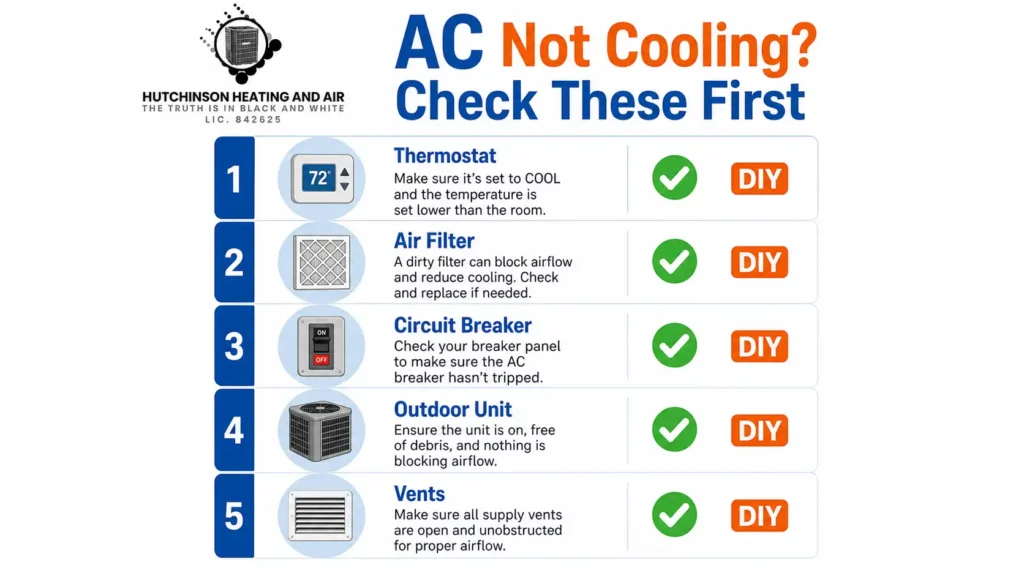
Work through these steps in order before calling for service:
Step 1: Set thermostat to “Cool,” fan to “Auto,” target temperature at least 5°F below current room temp
Step 2: Pull the air filter and inspect it replace if dirty
Step 3: Check your electrical panel for a tripped AC breaker and reset once if needed
Step 4: Walk to the outdoor unit clear any debris, confirm the fan is spinning when the system is running
Step 5: Check all supply vents are open and that no furniture or rugs are blocking return air grilles
Step 6: Let the system run for 15 minutes after completing the above steps
If cold air still isn’t coming through your vents after these steps, the cause is beyond DIY territory. Shutting the system down and scheduling a professional diagnostic while continuing to run a struggling system risks compressor damage.
Whether it’s a capacitor swap or a full refrigerant leak repair, our AC Repair Murrieta and Temecula team responds fast the same day in most cases during peak summer season.
DIY vs. Professional | Quick Reference Table
| Problem | DIY? | Estimated Cost |
| Thermostat setting | Yes | $0 |
| Air filter replacement | Yes | $5–$20 |
| Breaker reset (once) | Yes | $0 |
| Condenser rinse | Partial | $0 |
| Frozen coil thaw | Partial | $0 |
| Refrigerant leak repair | No | $200–$500 |
| Capacitor replacement | No | $150–$300 |
| Compressor repair/replace | No | $800–$2,500 |
| Duct sealing | No | $200–$700 |
Preventative Measures to Keep Your AC Blowing Cold All Summer
The most effective way to avoid an air conditioner not cooling on the hottest day of the year is consistent, simple maintenance:
- Check your filter every 30 days from May through September Temecula’s dust makes monthly checks essential during peak season
- Schedule your annual tune-up in March or early April: before the heat arrives, not during it when every HVAC company in the area is fully booked
- Keep 2 feet of clearance around your outdoor condenser year-round
- Consider a smart thermostat upgrade: modern smart thermostats can detect abnormal runtimes and alert you before a small problem becomes a breakdown
- Have ductwork inspected every 3–5 years: especially in homes with attic-run ducts
- Ask your technician about SCE and SoCalGas rebate programs: qualifying HVAC upgrades and efficiency improvements may be eligible for rebates that reduce your out-of-pocket cost significantly
Temecula & Murrieta Homeowners | What You Need to Know
The Inland Empire runs hotter and drier than most of Southern California. Sustained temperatures above 100°F during July and August push residential AC systems harder than manufacturer testing typically accounts for. System failures in this region during peak heat are not random; they’re predictable, and they’re preventable.
When outdoor temperatures stay above 100°F for multiple days in a row, AC systems experience stress on capacitors, refrigerant pressure limits, and compressor load simultaneously. This is why Temecula and Murrieta see a spike in AC service calls every July. Systems that were “fine” in May suddenly stop cooling under sustained extreme heat.
If your system requires full replacement, Riverside County requires permits for new HVAC installations. Working with a licensed, insured contractor CA License #842625 ensures the permit process is handled correctly and your installation meets current Title 24 energy efficiency standards. Hutchinson Heating and Air handles the entire process, including permit coordination, for local homeowners.
Final Thoughts
There’s never a good time for your air conditioner to stop blowing cold air but in Temecula and Murrieta summers, it’s a problem that needs to be addressed the same day it shows up. Start with the quick checks in this guide: thermostat, filter, breaker, outdoor unit. If those don’t solve it, don’t keep running the system and hoping the longer a struggling AC runs, the more expensive the eventual repair gets.
If you need professional help, our team at Hutchinson Heating and Air is ready. We offer same-day diagnostics, transparent repair estimates, and over 21 years of experience serving homeowners in Temecula and Murrieta. Our NATE-certified technicians carry the parts and tools to handle everything from capacitor swaps to full system replacements. Contact us today to schedule your diagnosis and get your home cooling again.
FAQs
Why is my AC running but not blowing cold air?
The most common reasons are a dirty air filter restricting airflow, incorrect thermostat settings (fan set to “ON” instead of “AUTO”), or a refrigerant leak. Start with the thermostat and filter if both are fine, a professional diagnostic is the next step.
Can I add refrigerant to my AC myself?
No. Refrigerant handling requires an EPA 608 certification, and purchasing refrigerant without one is illegal. More importantly, low refrigerant always indicates a leak adding refrigerant without fixing the leak is a waste of money that won’t hold.
How much does it cost to fix an AC not blowing cold air?
It depends entirely on the cause. Filter replacement costs $5–$20 and you can do it yourself. Refrigerant leak repair runs $200–$500. Capacitor replacement is $150–$300. Compressor repair or replacement can reach $800–$2,500. A diagnostic visit typically $75–$150 tells you exactly what you’re dealing with before committing to any repair.
Why does my AC blow cold air sometimes and not others?
Intermittent cooling usually points to a failing capacitor, a refrigerant level that’s borderline low, or a system that’s short-cycling due to incorrect sizing. All three are worth having a technician evaluate before the problem becomes complete failure.
Should I turn off my AC if it’s not cooling?
Yes if your AC is running but producing no cold air, turn it off. Running a system with a refrigerant leak, frozen coil, or failing compressor without addressing the root cause accelerates damage. Turn it off, check the basics (filter, thermostat, breaker), and call for service if those don’t resolve it.