Buying an AC unit sounds simple until you’re standing in the store staring at two completely different options with no idea which one fits your situation. If you’re debating window ac vs portable ac, you’re not alone. Most people get stuck here because both units look like they do the same job, but they work differently, cost differently, and suit different living situations.
Here’s the short answer: window AC units are more efficient and powerful for most rooms. But a portable AC makes more sense in specific situations, like apartments with strict rules or rooms with casement windows. By the end of this guide, you’ll know exactly which one to get.
Key Takeaways
- Window ACs cool more efficiently and cost less to run long term
- Portable ACs are easier to install and move room to room
- Your window type, lease terms, and room size should drive the decision
- Neither unit works well without access to a window for venting
- A mini split is worth considering if you need a permanent, quiet solution
Should I Get a Portable or Window AC Unit?
The right choice depends on your living situation, not just your budget. Window AC units are the better all-around option for most people. They cool larger spaces more effectively, use less energy, and are typically cheaper to buy. Portable units make sense when installation isn’t an option or flexibility matters more.
To make this decision well, it helps to understand how both units actually work.
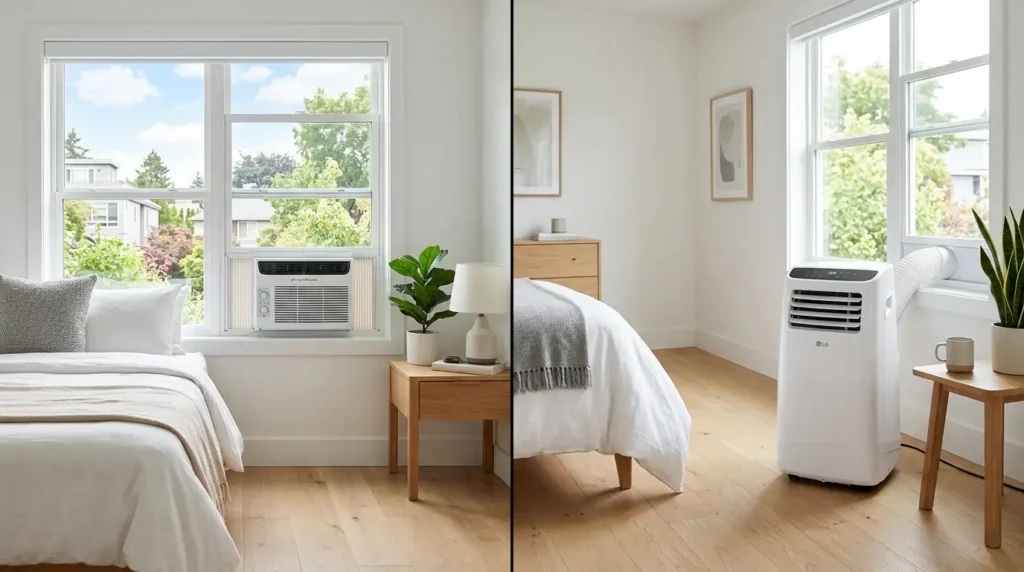
All air conditioners pull in hot air, run it over cooling coils, and push the heat outside. A window AC unit does this as one sealed box sitting in your window frame. A portable unit does the same thing, but the box sits on your floor and uses an exhaust hose to push hot air out through a window, sliding door, or ceiling vent.
That difference in design is what makes window units more efficient. Portable ACs exhaust heat from inside the room, which means some of that warm air leaks back in. Window units seal to the outside, so the heat leaves completely.
Window Air Conditioners vs Portable Air Conditioners: Side-by-Side
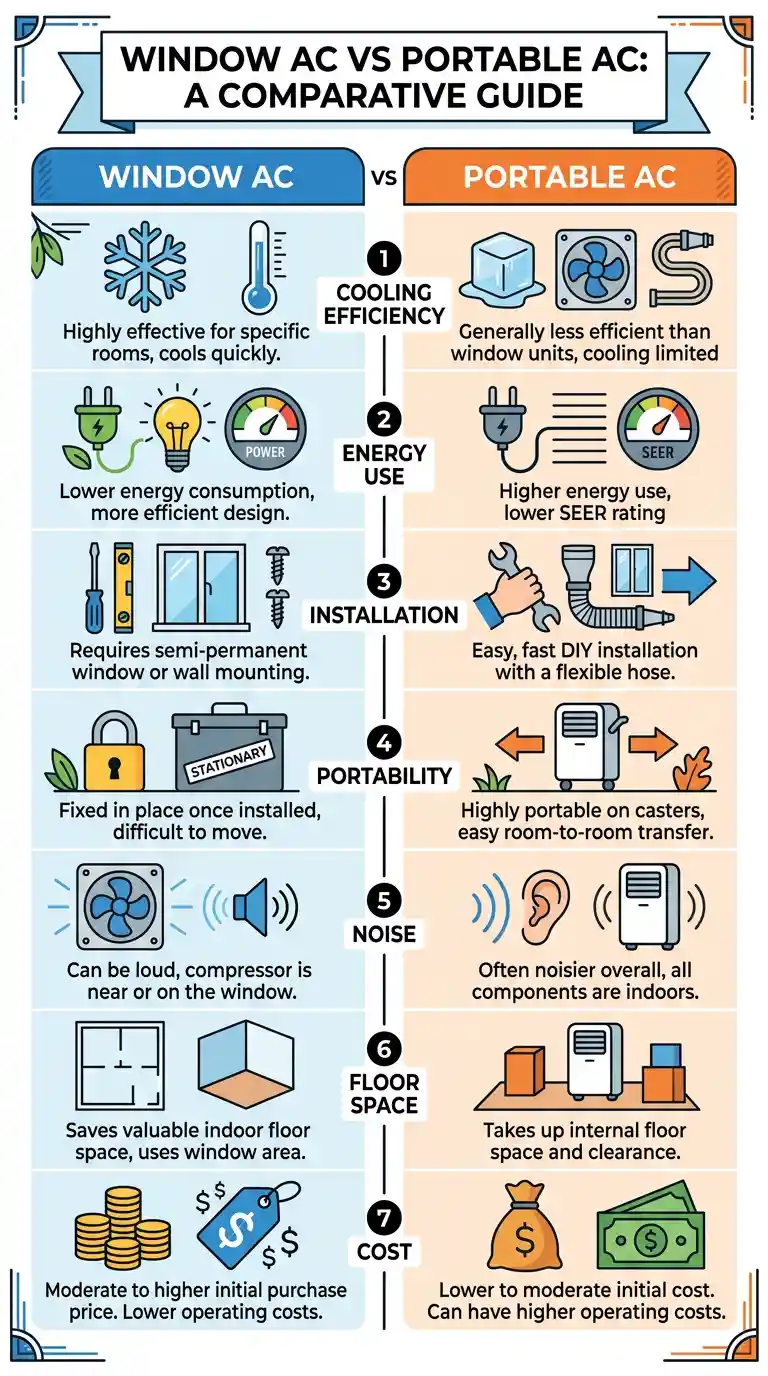
| Feature | Window AC | Portable AC |
| Cooling efficiency | Higher | Lower |
| Energy consumption | Lower | Higher |
| Installation | Moderate effort | Very easy |
| Portability | Fixed in window | Moves room to room |
| Noise level | Partially outside | Fully inside |
| Floor space used | None | Medium footprint |
| Best for | Long-term cooling | Flexible or temporary use |
| Average cost | $150 – $600 | $250 – $700 |
(Price ranges based on standard 8,000-12,000 BTU units as of 2024. Always verify current pricing with your retailer.)
What Are the Pros and Cons of Window Air Conditioners?
Window air conditioners are the more practical choice for cooling a dedicated room over an entire summer. They cool more square footage per dollar spent, run quieter inside your space, and don’t eat up floor space. For anyone with a standard single or double-hung window, they’re the stronger long-term investment.
Pros of window AC units:
- Better energy efficiency. Window units consistently outperform portable units on efficiency ratings. A 10,000 BTU window AC can cool a 450 sq ft room comfortably, while a portable unit with the same BTU rating may only handle 350 sq ft effectively.
- Lower noise inside. The compressor sits partially outside, so the loudest parts of the unit face away from you.
- No floor space used. It sits in the window frame. Your room layout stays exactly as it is.
- Lower running costs. Because window ACs move heat out more completely, they don’t have to work as hard. That shows up on your electricity bill over a long summer.
Cons of window AC units:
- Installation takes effort. Most window units weigh between 50 and 80 pounds. Getting one into position, especially on an upper floor, usually requires two people.
- They block your window. Once it’s in, natural light and the view from that window are gone for the season.
- Not all windows work. You need a standard single or double-hung window. Casement windows (the crank style) don’t work with most window AC units without special hardware.
What Are the Pros and Cons of Portable Air Conditioners?
Portable air conditioners are the right call when a window unit simply isn’t an option. They’re easy to install, require no permanent changes to your window, and can move room to room as needed. The trade-off is higher energy use and reduced cooling power compared to a window unit of the same size.
Pros of portable AC units:
- Easy to install. Unbox it, attach the exhaust hose to the window kit, and plug it in. No tools. No modifications. No second person needed.
- Works with tricky window types. Sliding windows, partially blocked windows, and even casement windows can accommodate a portable unit with the right kit.
- Flexibility. Roll it from the bedroom to the living room. Take it to a garage or covered porch. This is something no window unit can do.
- Apartment and rental friendly. Many HOAs and landlords prohibit window AC units because they’re visible from outside. A portable unit stays entirely inside, so it doesn’t break those rules.
Cons of portable AC units:
- Higher energy consumption. Portable ACs use more electricity to achieve the same cooling result. The DOE introduced a separate efficiency metric called SACC (Seasonally Adjusted Cooling Capacity) specifically for portable units because BTU ratings alone don’t capture the efficiency gap.
- Takes up floor space. You’re fitting a mid-sized appliance somewhere in your room. If the space is small, it becomes cramped quickly.
- Noisier indoors. The entire unit runs inside the room. The hum is always present when it’s on.
- I still need a window. Despite the name, a portable AC still requires a window or vent opening for the exhaust hose. It’s not truly windowless.
How Do Window and Portable ACs Compare in Terms of Cost and Efficiency?
Window units win on both cost and efficiency for most buyers. A comparable window AC typically costs $50 to $150 less upfront than a portable unit, and runs at lower operating costs over time because it moves heat out of the room more completely.
On the efficiency side, the gap is real. The U.S. Department of Energy rates portable and window units under different standards precisely because portable ACs are less efficient by design. When comparing units, look at the EER (Energy Efficiency Ratio) for window units and the SACC rating for portable units. Don’t compare BTU numbers directly between the two types because it’s not an accurate apples-to-apples comparison.
If energy bills are a concern and you’re planning to run the unit all summer, a window AC will save you money over the long haul.
Which One Should You Choose?

Choose a window AC if you have the right windows, plan to cool one room consistently, and want the most efficient setup for the cost. Choose a portable AC if your building has restrictions, your windows aren’t compatible, or you need a unit that moves between rooms.
Here’s a practical way to decide:
Get a window AC if:
- You have single or double-hung windows
- You’re staying put for the full summer or longer
- Energy efficiency and cooling power are your top priorities
- You don’t mind the one-time installation effort
Get a portable AC if:
- Your HOA or landlord bans window units
- You have casement or sliding windows
- You need to cool more than one room at different times
- You want to avoid any permanent installation
If you’ve outgrown both options and need whole-home cooling, a mini split system is worth a serious look. It’s quieter, more efficient, and doesn’t require ductwork.
At Hutchinson Heating and Air, we help homeowners and renters in Temecula and Murrieta figure out exactly what their space needs, whether that’s a portable unit, a window AC, or a full AC installation. If you’re not sure what’s right for your home, our ac installation services in Temecula & Murrieta team can walk you through the options without any pressure.
Final Thoughts
The window ac vs portable ac debate really comes down to one question: what does your living situation actually allow? Window units are the stronger performer on almost every technical measure. But if your building, windows, or lifestyle don’t support one, a portable AC is a solid, practical backup.
Pick the unit that fits your real-world constraints, not just the one with the best specs on paper. And if the heat in Temecula or Murrieta has you second-guessing a small unit altogether, it might be time to think bigger.
FAQs About Window AC vs Portable AC
Is a window AC better than a portable AC?
For most people, yes. Window AC units are more energy-efficient, cool larger spaces more effectively, and cost less to run over time. A portable AC is the better choice only when a window unit isn’t physically or legally possible.
Can a portable AC cool a room as well as a window unit?
A portable air conditioner can cool a room, but not as effectively as a window unit of the same BTU rating. Because portable units exhaust heat from inside the room, some warm air leaks back in, reducing overall cooling performance.
Do portable ACs use more electricity than window units?
Yes. Portable ACs generally consume more electricity to achieve the same cooling output. The DOE’s SACC rating was introduced specifically because BTU comparisons between portable and window units were misleading buyers about actual energy use.
What if my apartment doesn’t allow window AC units?
A portable AC is your best option. It stays entirely inside the room, requires no permanent installation, and doesn’t violate most HOA or building restrictions since nothing is mounted to or visible from the window.
What size AC do I need for my room?
A general rule: you need roughly 20 BTUs per square foot of floor space. A 150 sq ft room needs about 5,000 BTUs. A 400 sq ft room needs around 10,000 BTUs. Always size up slightly with portable units since they’re less efficient than their BTU rating suggests.
Is a mini split better than both?
For long-term home comfort, yes. A mini split is quieter, more efficient, and doesn’t block windows or take up floor space. It’s a bigger upfront investment, but it’s the right call if you’re cooling a permanent space and want the best performance.